Solar Eclipse 2027 in Luxor, Egypt: The Complete Guide
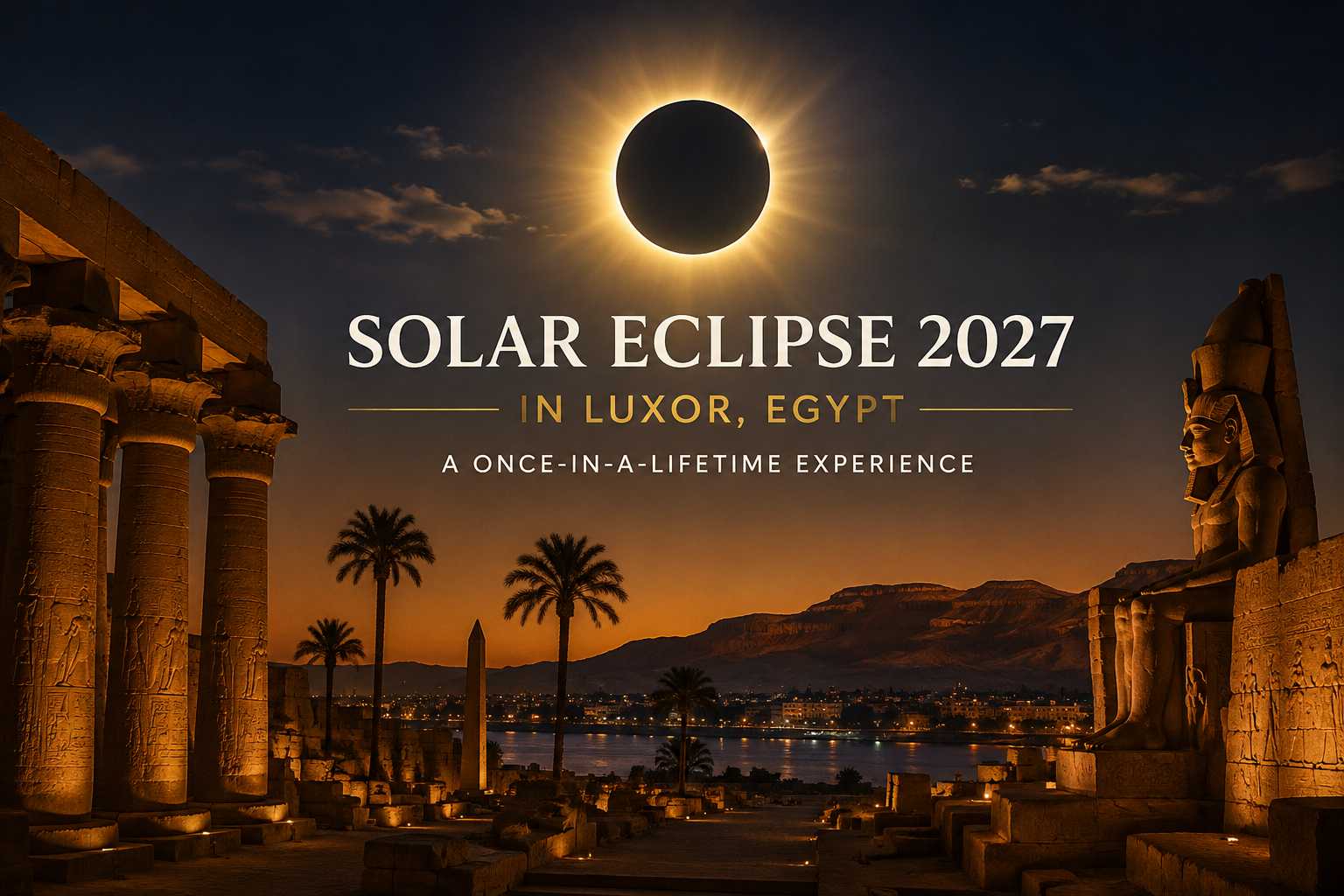
On August 2, 2027, the Moon will pass directly between the Earth and the Sun, creating a total solar eclipse along a path crossing parts of Europe, North Africa and the Middle East. Luxor, Egypt will be inside the path of totality.
For visitors, this is much more than an astronomical event. Luxor combines totality with the landscape of ancient Thebes, the Nile and some of the world’s most important archaeological monuments.
Date: August 2, 2027
Maximum eclipse: approximately 1:05 PM local time
Totality: approximately 6 minutes 22 seconds
Location: Luxor, Egypt
When is the 2027 solar eclipse in Luxor?
The eclipse will unfold in several phases. In Luxor, current astronomical calculations place the beginning of the partial eclipse at approximately 11:40 AM local time. Maximum eclipse occurs at around 1:05 PM, and the partial eclipse ends at approximately 2:26 PM.
| Phase | Approximate Luxor Time |
|---|---|
| Partial eclipse begins | 11:40 AM |
| Maximum eclipse | 1:05 PM |
| Totality | About 6 minutes 22 seconds |
| Partial eclipse ends | 2:26 PM |
These are current published calculations and should be checked again against authoritative astronomical data as the event approaches.
How long will totality last in Luxor?
The most extraordinary part of the 2027 eclipse is totality — the brief period when the Moon completely covers the bright disk of the Sun for observers inside the path of totality.
In Luxor, totality is currently calculated at approximately 6 minutes and 22 seconds. That makes the city one of the particularly interesting destinations for travelers who want to experience a long period of darkness during a total solar eclipse.
What makes a total solar eclipse different?
A partial eclipse and a total eclipse are not the same experience. During a partial eclipse, part of the Sun remains visible. During totality, the bright solar disk is completely covered for observers inside the path.
For those few minutes, the sky can become dramatically darker, the solar corona can become visible and the atmosphere of the landscape can change in ways that are difficult to reproduce in photographs.
During the partial phases, never look directly at the Sun without appropriate solar eye protection. Ordinary sunglasses are not a substitute for proper solar viewing equipment.
Why is Luxor such a special place for the 2027 eclipse?
Luxor is the modern city surrounding much of the landscape of ancient Thebes. The Nile divides the destination between the East Bank and the West Bank, with temples, tombs, archaeological sites and local communities spread across both sides.
That makes the 2027 eclipse unusual from a travel perspective. Visitors can experience a major astronomical event while surrounded by thousands of years of Egyptian history.
Thousands of Years of History
Luxor preserves the archaeological landscape of one of ancient Egypt’s greatest cities.
A Unique Landscape
The Nile creates the natural divide between Luxor’s East and West Banks.
A Rare Astronomical Event
Experience several minutes of totality in one of Egypt’s most historic destinations.
Where is the best place to watch the 2027 eclipse in Luxor?
Choosing where to watch totality is one of the most important decisions of the entire trip. The best location is not necessarily the one with the most famous view. It should also offer a clear horizon, comfortable access, enough space and a realistic plan for transportation and crowd conditions.
Because eclipse-day conditions can change, viewing locations should be verified closer to August 2, 2027. Access rules, venue policies, road conditions and local arrangements may change as demand increases.
East Bank
Luxor’s East Bank is the more urban side of the city. It offers easy access to restaurants, cafés, shops and many hotels, while also being home to major monuments such as Karnak Temple and Luxor Temple.
Best for convenience
A practical choice for visitors who want to remain close to restaurants, city services and transportation.
West Bank
The West Bank has a quieter atmosphere and is surrounded by the archaeological landscape of ancient Thebes. It is home to major attractions including the Valley of the Kings, Hatshepsut Temple and the Colossi of Memnon.
Best for atmosphere
A strong option for travelers who prefer a quieter setting and want to combine the eclipse with the monuments of Luxor’s West Bank.
The Nile
The Nile creates a unique setting and an open visual landscape, but eclipse-day arrangements involving boats or river viewing should be confirmed with the operator and local authorities well in advance.
Private rooftops and viewing areas
Private rooftops and controlled viewing areas may offer convenient access, but visitors should verify capacity, sightlines, permission to use the space and any special eclipse-day arrangements.
What should you do before the eclipse?
One of the biggest mistakes travelers can make is treating eclipse day as the entire trip. Luxor deserves several days, and spreading your sightseeing before the eclipse can make the experience much less stressful.
Karnak Temple
Explore one of ancient Egypt’s greatest temple complexes before the eclipse.
Valley of the Kings
Discover the royal tombs of ancient Egypt and the landscape of ancient Thebes.
Experience the River
Take time to enjoy Luxor’s Nile landscape before the main event.
What should you do after the eclipse?
The end of totality is not the end of the eclipse. The partial phase continues afterward, but for travelers, the rest of the day is also an opportunity to slow down and enjoy Luxor.
You may want to keep your schedule light after the eclipse rather than planning a long excursion immediately. The combination of heat, crowds, excitement and an unusual afternoon makes a flexible schedule much easier.
How many days should you spend in Luxor for the eclipse?
There is no single perfect answer, but visitors traveling internationally for a once-in-a-generation event should consider staying long enough to build in some flexibility.
A longer stay also means that the eclipse is only one part of the trip. You can explore the temples and tombs, experience local food, visit both banks of the Nile and leave room for unexpected discoveries.
Do not build a once-in-a-lifetime eclipse trip around a single morning. Give yourself time, flexibility and backup plans.
What is Luxor like in August?
August is one of the hottest periods of the year in Luxor. Visitors should plan around the heat rather than assuming they can follow a normal sightseeing schedule.
Hydration, shade, lightweight clothing, sun protection and sensible timing are especially important. Historical climate averages can help with planning, but they are not a forecast for August 2, 2027.
How to photograph the 2027 eclipse
Eclipse photography requires preparation. The equipment you use for travel photography is not necessarily ready for direct solar photography during the partial phases.
Practice beforehand
Know your camera controls, batteries, memory cards and focus settings before eclipse day.
Use proper solar filtration
A suitable solar filter is essential when photographing the Sun during the partial phases.
Keep your setup stable
A tripod can make a telephoto setup easier to manage and can reduce the stress of changing your framing.
Do not miss totality
Decide in advance how much of the experience you want to photograph and how much you want to watch.
Can you visit Luxor with children for the eclipse?
Absolutely, but families should plan the day differently. Children need proper solar viewing protection during the partial phases, and parents should think about shade, water, food, transportation and a comfortable viewing environment.
The eclipse can also become an excellent educational experience. Before the trip, children can learn about the Sun, Moon and Earth and then see the geometry of an eclipse happen in real life.
What should you pack?
| Item | Why it matters |
|---|---|
| Proper solar viewing protection | Safe viewing during partial phases |
| Water bottle | Hydration in the August heat |
| Hat and sun protection | Protection from direct sunlight |
| Phone and power bank | Navigation, communication and photography |
| Camera equipment | For visitors planning eclipse photography |
| Comfortable shoes | Walking around archaeological sites |
| Travel documents | Easy access during the trip |
Is it safe to look at the eclipse?
During the partial phases, use appropriate solar eye protection. Ordinary sunglasses do not make direct solar viewing safe. Cameras, binoculars and telescopes also require suitable solar filters designed for the equipment.
Because safety guidance can evolve, visitors should check current information from NASA and other reputable astronomical authorities before eclipse day.
Frequently asked questions
What day is the solar eclipse in Luxor?
The total solar eclipse occurs on August 2, 2027.
What time is the eclipse in Luxor?
Current calculations place the beginning of the partial phase at approximately 11:40 AM, maximum eclipse around 1:05 PM and the end of the partial phase around 2:26 PM local time.
How long is totality in Luxor?
Approximately 6 minutes and 22 seconds based on current published calculations.
Is Luxor inside the path of totality?
Yes. Luxor is inside the path of totality for the August 2, 2027 total solar eclipse.
Can I photograph the eclipse with my phone?
You can photograph the overall atmosphere, landscape and surroundings with a phone, but photographing the Sun directly during the partial phases requires appropriate solar protection and careful technique.
Should I stay in Luxor after the eclipse?
For most visitors, yes. Luxor has enough archaeological and cultural attractions to justify several days, and staying longer reduces pressure around eclipse day.
Start planning your Luxor eclipse experience
The August 2, 2027 eclipse offers a rare combination of astronomy, history and travel. Luxor provides the setting, but preparation will determine how enjoyable the experience becomes.
The Eclipse
Explore the dedicated eclipse guide.
Luxor
Discover ancient Thebes and the modern city.
Guides
Browse practical eclipse planning resources.
Follow the Luxor Eclipse Journal as we publish detailed guides about viewing locations, photography, safety, travel planning and Ancient Egyptian history ahead of August 2, 2027.